Wednesday, April 27, 2022

God and Government

Between Facebook, Twitter, and the ever-expanding op-ed and “analysis” sections of online news sites, it’s hard to go online without finding political opinions. Too bad they all disagree with each other.

Putin invaded Ukraine because Biden is weak. Putin invaded Ukraine because the US has been encroaching on Russia’s sphere of influence for years. Putin would have invaded Ukraine regardless. Biden is doing too much for Ukraine and should pay more attention to matters at home; Biden can’t do more for Ukraine, because we might provoke Russia; Biden should do more for Ukraine and should make Russia afraid of provoking us. Biden is doing great; Trump would do much better; Trump would do much worse.

Jesus said there would be wars and rumors of war (Mt 24:6).

Inflation is transitory and not much to worry about; inflation is a huge problem, and we should vote the politicians responsible out of office. Inflation is because of too much pandemic spending, so we should spend less. Inflation is because of supply chain problems or human infrastructure limitations, and we should spend more to address those.

Jesus said that we would always have the poor (Mt 26:11).

Covid arose naturally from a wet market; Covid leaked from a lab; Covid was a Chinese bioweapon; Covid was the product of an American conspiracy. The best way to deal with it is mask mandates and lockdowns; mask mandates and lockdowns are harmful and should be avoided; we need more vaccination; we need less vaccination.

Revelation says that death and pain will be removed in the new heaven and new earth (Rev. 21:4) - but not before then.

And I enjoy some of these discussions, and I’ve engaged in a fair number myself. But I can’t help but think there’s sometimes some arrogance there. I am neither a foreign policy expert nor an economist nor an epidemiologist; I can have an informed opinion, but humility should remind me that I likely don’t know better than the professionals, and I may not have much basis for thinking that my preferred remedy would actually work.

Within my chosen niche of software development, we have plenty of our own opinions to argue about - enough that these have earned the tongue-in-cheek name of “holy wars.” Which text editor should you use to write source code? Which hardware design is best? Which programming language is best? Should you use a Mac or a PC? One of the most famous holy wars is whether programmers should format their source code with the tab key or the spacebar; this has gained enough notoriety that it made an appearance on HBO’s “Silicon Valley.”

Even tabs versus spaces, though, pales next to the debate of Windows versus Linux. For years, an assortment of developers and upstart businesses pushed Linux, a free operating system, as an alternative to Microsoft Windows, backed by Microsoft’s billions of dollars and monopoly business power. Countless marketing initiatives, technical whitepapers, and websites pushed one or the other. Developers on both platforms competed to write the best Windows-only or Linux-only software. Emotions ran high. In one of the more noteworthy examples, Dan Greer, a cybersecurity researcher, wrote a 2003 report arguing that Microsoft Windows’ dominance was a threat to national security. He was fired from his consultancy the day the report was released.

It turns out that the answer to Windows versus Linux is, depending on how you slice it, either “Both” or “Who cares?” “Both” is because businesses still happily run Windows, while servers and cloud computing (even at Microsoft) often run Linux; “who cares?” is because the operating system on your desktop matters little when all of your activities are conducted through a web browser, and mobile phones and tablets have replaced desktop and laptop computers, both as a focus of innovation and as many people’s primary computing device. Time and change rendered the entire debate irrelevant in ways that neither side foresaw.

Dan Greer is relevant to this discussion for reasons other than his Windows-versus-Linux foray. In 2013, he delivered a talk, “Tradeoffs in Cyber Security”:

I previously worked for a data protection company. Our product was, and I believe still is, the most thorough on the market. By “thorough” I mean the dictionary definition, “careful about doing something in an accurate and exact way.” To this end, installing our product instrumented every system call on the target machine. Data did not and could not move in any sense of the word “move” without detection. Every data operation was caught and monitored. It was total surveillance data protection. Its customers were companies that don’t accept half-measures. What made this product stick out was that very thoroughness, but here is the point: Unless you fully instrument your data handling, it is not possible for you to say what did not happen. With total surveillance, and total surveillance alone, it is possible to treat the absence of evidence as the evidence of absence. Only when you know everything that did happen with your data can you say what did not happen with your data…

We all know the truism, that knowledge is power. We all know that there is a subtle yet important distinction between information and knowledge. We all know that a negative declaration like “X did not happen” can only [be] proven true if you have the enumeration of everything that did happen and can show that X is not in it. We all know that when a President says “Never again” he is asking for the kind of outcome for which proving a negative, lots of negatives, is categorically essential. Proving a negative requires omniscience. Omniscience requires god-like powers…

John Gilmore famously said, “Never give a government a power you wouldn’t want a despot to have.” I might amend that to read “Never demand the government have a power you wouldn’t want a despot to have.”… When you embark on making failure impossible, and that includes delivering on statements like “Never again,” you are forced into cost-benefit analyses where at least one of the variables is infinite. [Emphasis added.]

I don’t know Greer’s religious beliefs - if he’s actually trying to make a theological point, or if he’s using (to him) nothing more than a vivid metaphor. But he’s right. In some of the more extreme versions of our political debates - and in some of what we ask our governments to do or seem to think they can do - we act like war or poverty or disease would cease to be urgent issues if our opinions prevail. In doing so, we claim to solve problems that Jesus himself says are not fully solvable in this lifetime. At best, we’re setting ourselves up for disappointment; at worst, we’re asking fallible humans to try to claim enough power to do God’s job. Bob Weinz at Christianity Today made a similar point in 2005, reflecting upon 9/11:

Last March former White House terrorism adviser Richard Clarke told the National Commission on Terrorist Attacks Upon the United States that the U.S. government “failed to prevent the tragedy of 9/11.” He proceeded to apologize for that failure… Clarke seemed to presume that “your government” should somehow have been able to anticipate and prevent evil from happening—both the evil that we call natural disasters, and the evil that comes directly from the hearts and hands of evil people. It is a false premise. To presume the government’s ability to prevent such a catastrophe is to assume that it possesses qualities and abilities that no person, let alone a government, can ever possess. Omniscience and omnipotence are qualities that we ascribe only to God.

There’s a saying: “Opinions are like armpits. Everyone has a couple, and most of them stink.” I saw a more positive alternative online: “Opinions are like luggage: expensive, and heavy to carry around, so don’t take more than you need.” Paul wrote to “reject foolish and ignorant controversies because you know they breed infighting” (2 Tim 2:23) and to “avoid foolish controversies, genealogies, quarrels, and fights about the law because they are useless and empty” (Titus 3:9). There’s nothing automatically wrong with having opinions, debating, and discussing them. It can be an important part of loving God with all of our minds and trying to use our gifts and positions to serve others. But let’s practice humility, realizing that we may easily be wrong. Let’s travel lightly, saving our time and energy for people and service. Let’s avoid foolish controversies, remembering that time and change will render so much of these moot. Let’s remember that we ultimately depend on Jesus to solve the world’s fallenness, rather than hoping in or foolishly empowering our institutions to try and do so.

Saturday, April 16, 2022

Psalm 22

Sometimes, I think, we may not give the Psalms enough credit. We read them for moral lessons (like the importance of God’s Word from Psalm 119), or comfort (Psalm 23), or as prophecies of Christ (such as Psalm 110). Or we use them as the basis for praise songs like U2’s “40” (Psalm 40) or Third Day’s “Your Love Oh Lord” (Psalm 36).

And all of those are good and true and wonderful. But the Psalms are more than that; it’s the prayer book of the Bible, and the prayers and praises written within it can become part of our prayers, shaping our thoughts and attitudes towards God and giving us the words to say if we don’t know how to pray. As my grandfather used to say, the book of Psalms is unique because, in it, humanity’s words to God become part of God’s Word to humanity.

What would it look like to pray Psalm 22 as our prayer?

My God, my God, why have you abandoned me?
I groan in prayer, but help seems far away.
My God, I cry out during the day,
but you do not answer,
and during the night my prayers do not let up.
You are holy;
you sit as king receiving the praises of Israel.
In you our ancestors trusted;
they trusted in you and you rescued them.
To you they cried out, and they were saved;
in you they trusted and they were not disappointed.
But I am a worm, not a man;
people insult me and despise me.
All who see me taunt me;
they mock me and shake their heads.
They say,
“Commit yourself to the Lord!
Let the Lord rescue him!
Let the Lord deliver him, for he delights in him.”
Yes, you are the one who brought me out from the womb
and made me feel secure on my mother’s breasts.
I have been dependent on you since birth;
from the time I came out of my mother’s womb you have been my God.
Do not remain far away from me,
for trouble is near and I have no one to help me.
Many bulls surround me;
powerful bulls of Bashan hem me in.
They open their mouths to devour me
like a roaring lion that rips its prey.
My strength drains away like water;
all my bones are dislocated.
My heart is like wax;
it melts away inside me.
The roof of my mouth is as dry as a piece of pottery;
my tongue sticks to my gums.
You set me in the dust of death.
Yes, wild dogs surround me—
a gang of evil men crowd around me;
like a lion they pin my hands and feet.
I can count all my bones;
my enemies are gloating over me in triumph.
They are dividing up my clothes among themselves;
they are rolling dice for my garments.
But you, O Lord, do not remain far away.
You are my source of strength. Hurry and help me!
Deliver me from the sword.
Save my life from the claws of the wild dogs.
Rescue me from the mouth of the lion
and from the horns of the wild oxen.
You have answered me.
I will declare your name to my countrymen.
In the middle of the assembly I will praise you.
You loyal followers of the Lord, praise him.
All you descendants of Jacob, honor him.
All you descendants of Israel, stand in awe of him.
For he did not despise or detest the suffering of the oppressed.
He did not ignore him;
when he cried out to him, he responded.
You are the reason I offer praise in the great assembly;
I will fulfill my promises before the Lord’s loyal followers.
Let the oppressed eat and be filled.
Let those who seek his help praise the Lord.
May you live forever!
Let all the people of the earth acknowledge the Lord and turn to him.
Let all the nations worship you.
For the Lord is king
and rules over the nations.
All the thriving people of the earth will join the celebration and worship;
all those who are descending into the grave will bow before him,
including those who cannot preserve their lives.
A whole generation will serve him;
they will tell the next generation about the Lord.
They will come and tell about his saving deeds;
they will tell a future generation what he has accomplished.

On Good Friday, we read this as referring to Christ. And we should! The details of Christ’s death - pinned or pierced hands and feet, thirsty, surrounded by enemies, with sarcastic taunts that God should save him, his clothes divided up and used as gambling prizes - are uncannily accurate for something written one thousand years before. Clearly, the Spirit spoke through David, to enable him to prophesy. But I don’t think that David necessarily knew he was prophesying; instead, I think, he spoke metaphorically about his own life, and his prayer was truer than he knew.

David could have written Psalm 22 in response to several circumstances in his own life. Saul, his master and the anointed king of Israel, went insane and tried to kill him; David’s son Amnon raped his daughter Tamar; his son Absalom conspired against him, forcing him to flee Jerusalem for his life; his trusted advisor Ahithophel betrayed him and joined Absalom’s rebellion; his son Adonijah tried to steal the throne in David’s old age.

Since the Psalms are the prayer book of the Bible, and if David initially wrote Psalm 22 about his own life rather than Christ’s, then can we pray it, too? I believe we can. Most of us have experienced times when God seemed to not answer, or when his help seemed far away. We haven’t (I hope) had enemies like David’s, but we have experienced enemies; we’ve seen people taunt believers and sarcastically dismiss God’s help; we may have felt times when our strength drains away, when our hearts are like wax. Praying Psalm 22 helps us give words to these experiences. And it also reminds us, as David reminded himself, that God protected our physical and spiritual ancestors; that he has provided for us since we came out of our mothers’ wombs; that we look forward to praising God for his response; that nations and future generations will acknowledge God. And remembering God’s faithfulness in the past, both to past believers and in our own individual lives, and remembering his promises for the future can help us in the present.

What does it look like to pray Psalm 22 as our prayer on Good Friday? Good Friday reminds us that, just as David’s words in Psalm 22 were truer than he knew and ultimately applied to Christ far more directly than they did to David, our own prayers are truer than we know. If we feel that God does not answer, Jesus felt that too; if we feel weak or despondent, Jesus felt so more; if we face opposition from others (either personal hostility from individuals or generalized rejection or indifference of a fallen society), Jesus received far worse. And he chose to do so: all the suffering that David prayed, that we pray, Jesus voluntarily took upon himself on the cross, to defeat evil and show his love for us. All the pain that believers throughout history have prayed, all the pain from believers and unbelievers alike that has gone unspoken, Jesus took upon himself. Not only that, but all the times when we’re the enemy - when, knowingly or unknowingly, we’re the ones hemming others in, piercing them or pinning them down, acting like we don’t believe in God’s help, leaving someone feeling weak or in despair - Jesus took that upon himself too.

Because Jesus didn’t just pay the penalty for our sins on the cross (as if the word “just” could apply to so great a salvation). Easter shows us that God the Son fully identified with humanity; that, whatever the depths of our fallenness and suffering, Jesus did not exempt himself from that; that we can therefore trust in him and his love.

Monday, April 11, 2022

Four Anecdotes

One

There’s a blog called Coffee & Covid that made the rounds a couple of times on Facebook during the pandemic, so several months ago, while the delta variant was making the news, I took a look at one of the posts. The author, a Christian lawyer, makes the following arguments:

  1. Covid (and the delta variant in particular) aren’t nearly as bad as they’re made out to be, and the Covid vaccines aren’t as helpful as they’re made out to be.
  2. Culture is surrendering to a “Spirit of Fear” about Covid. Fear is a spiritual problem, not a medical or scientific or political problem. It’s manifesting itself in anxiety, depression, and more. The Bible teaches is not to fear (Phil. 4:6). The church needs to boldly speak out against this Spirit of Fear.

I could argue with some of his first point, except that I’ve made a policy to not get involved in Covid debates online. I agree with much of his second point: Covid has caused a lot of mental harm, and the Bible does command us not to fear. I think that fear is an “acceptable” sin among Christians - the prevalence of anxiety and stress and worry among Christians (not just around Covid) suggests that we aren’t taking Scripture’s teachings seriously here. If the church can speak to this and can help people with their fears and anxieties, as the Coffee & Covid post argues that it should, then that’s great!

I’m more interested in the relationship between the first and second points. If Covid isn’t nearly as bad as it’s made out to be, and if the dilemma about whether or not to get vaccinated isn’t as high-stakes as it’s made out to be, then fear is an intellectual and emotional error, not a spiritual problem. (In other words, we don’t need to fear because there isn’t really anything to be afraid of.) Saying that fear is a spiritual problem means that, even if whatever we’re afraid of is genuinely terrifying as all get-out, we need to trust God regardless.

Two

Donald Trump’s position on abortion has been the focus of much scrutiny over the last several years. In older interviews, he described himself as pro-choice, but starting in 2011, he said that he was pro-life:

I’m pro-life, but I changed my view a number of years ago. One of the reasons I changed – one of the primary reasons – a friend of mine’s wife was pregnant, in this case married.

She was pregnant and he didn’t really want the baby. And he was telling me the story. He was crying as he was telling me the story. He ends up having the baby and the baby is the apple of his eye. It’s the greatest thing that’s ever happened to him.

He elaborated in a 2015 debate:

“Friends of mine years ago were going to have a child, and it was going to be aborted. And it wasn’t aborted. And that child today is a total superstar, a great, great child. And I saw that. And I saw other instances.”

In another exchange,

he responded to a reporter who wondered if he would have become pro-life had the child been a “loser”: “Probably not, but I’ve never thought of it. I would say no, but in this case it was an easy one because he’s such an outstanding person.”

In some of the ensuing abortion debates, some pro-life advocates pushed back on Trump; they argued that abortion should be opposed because human life is intrinsically valuable, not because the fetus may go on to be a superstar and an outstanding person.

Three

In Joy at Work, Dennis Bakke, a Christian business leader, talks about his philosophy and experiences as the head of AES, a multi-billion-dollar international energy company. When he and cofounder Roger Sant started the company, he adopted the philosophy that enjoyment - joy - at work came from making meaningful, challenging, and rewarding decisions, and companies’ approach of a centralized hierarchy of authority stifled employees’ ability to do this. AES therefore radically decentralized its decision-making; decisions such as HR, salary, and acquisitions were pushed out as far as possible to those most directly affected, while executives merely gave advice. Bakke also made a commitment to operate the business on Christian principles and to consider its impact on society, employees, suppliers, and customers, instead of prioritizing the interests of the shareholders.

When AES went public, they included the following text in their public-offering memo:

Adherence to AES’s Values - Possible Impact on Results of Operations. An important element of AES is its commitment to four major ‘shared’ values: to act with integrity, to be fair, to have fun, and to be socially responsible. See ‘Business - Values and Practices.’ AES believes that earning a fair profit is an important result of providing a quality product to its customers. However, if the Company perceives a conflict between these values and profits, the Company will try to adhere to its values - even though doing so might result in diminished profits or forgone opportunities. Moreover, the Company seeks to adhere to these values not as a means to achieve economic success, but because adherence is a worthwhile goal in and of itself. The Company intends to continue these policies after this offering. (p.39)

Bakke explains that, when they submitted this memo to the SEC, the SEC suggested that they move this paragraph under “Special Risk Factors,” advising potential investors of risks of investing in the company. He writes:

In our case, the SEC thought our values were a hazard… I loved it. I could now say that the U.S. government thought it was very risky to attempt to operate a business with integrity, fairness, social responsibility, and a sense of fun.

AES was very successful. Bakke goes on to write, though, that explaining its values was a constant challenge; the board of directors kept thinking that AES was successful because of its values and its radical approach to decision-making, and Bakke kept trying to explain that AES followed its values because they believed it was the right thing to do, and he would continue to do it even if it wasn’t successful. He ultimately failed; when the energy industry was rocked by the Enron scandal in 2001 and AES’s stock price tumbled, the board decided that its philosophy was no longer working, and they forced Bakke out.

Four

I didn’t watch the 2014 movie God’s Not Dead, but I heard enough about it that I’m familiar with the basic plot. A Christian college student named Josh enrolls in a class taught by an aggressive atheist who challenges the class, “God is dead.” Josh ends up being challenged to a formal debate with the professor. At the end of the movie, Josh is vindicated: he wins the debate, and the professor reveals that his atheism stems from anger with God at some past tragedy in his life.

The movie was very popular within evangelical circles: it cost $2 million to make, grossed $62 million, and spawned three sequels. I felt like the ending was a little bit of wish fulfillment, though; evangelicals feel harassed or looked down upon by broader culture (especially the cultural elites of media and academia), so we wanted to see a movie where the Christian “won.” If Joshua had lost the debate (which, humanly speaking, would be likely, given the professor’s broader learning and experience), flunked out of college, and worked as a Starbucks barista for the rest of his life, it would still be a story of faithful Christian witness; in fact, compared to many historical Christian witnesses (the original meaning of the Greek word “martyr”), he would have gotten off easy.

Why?

What do a pandemic blog post, a president’s pro-life conversion, a billion-dollar energy company, and a possibly kitschy Christian film have in common? All of them confuse means with ends; all of them confuse the value that a thing can bring with the value of the thing itself.

We say that God’s eye is on the sparrow and that we don’t have to fear anything, yet we can’t help but try and argue that our fears are smaller instead of remembering that God is greater. Truly conquering the spirit of fear would mean saying that, even if all of the worst doomsayer predictions of Covid were right, and it killed one of out ten people and could spread through surfaces and even the briefest outdoor contact and required brutal lockdowns and became endemic with unending variants, we can still know that our heavenly Father will provide all the things that we need (Mt. 6:31-33).

If Trump’s friend’s baby really did help Trump realize the value of life, then that’s great. But the reason we’re pro-life is because we believe that human life has inherent value, because it’s made in the image of God, and that life has value and is worth protecting even if Trump’s friend’s baby grew up to be a total scuzzbucket who brought his parents nothing but grief and heartache.

Countless business books, articles, and talks espouse virtues such as leadership, teamwork, trust, communication, and responsibility and talk about how these can promote success in business. Few business leaders are willing to say, like Bakke, that the real reason to talk about these good traits is because they are, in fact, good, and they remain good even if they don’t “pay off“ and even if they hurt a company in the marketplace.

And I appreciate God’s Not Dead’s depiction of a Christian willing to stand firm for his faith. But I can’t help but think that it would not have been nearly as successful if it didn’t also show him winning the debate and succeeding in college as a result of standing firm for his faith. (Case in point: Silence, a movie about the brutal persecution of Christians in 17th century Japan, featuring a Catholic missionary who renounced his faith, earned only $22 million against its $50 million budget, despite critical acclaim and an Academy Award nomination.)

And so forth. So many of the stories, fables, and works of fiction, both for children and adults, show someone doing something good and then being rewarded for it. Good stewardship is encouraged as a means of achieving financial success, instead of simply the right way to treat the finite resources God gives us. Christian purity culture encouraged abstinence before marriage by saying that it would result in better sex within marriage, even though that risks getting further involved in culture’s over-sexualization rather than offering a meaningful alternative. Left-wing writers, in a well-intentioned effort to oppose inequality and discrimination, insist that there are no meaningful differences in skill or aptitude between men and women; maybe so (the topic of gender differences is worth books by itself), but this argument leaves unchallenged the deeper lie that our skills and aptitude determine our worth, that someone who’s smart or a math genius or socially adept is simply better than someone who isn’t. Right-wing writers uphold Christian values as part of what makes Western civilization great; maybe so, and following God’s ways can certainly brings blessings, but we’re better served (and better serve) by quietly living out Christian values (1 Pe 3:15-16) than by getting involved in culture wars over Western civilization.

Most of us within evangelical churches are very aware of the dangers of the prosperity gospel: the “name-it-and-claim-it” idea that God will always reward us with financial success, physical health, and temporal happiness, as long as we approach him with the right kind of prayer and sufficient faith. But the prosperity idea can be much more subtle than that: the idea that it’s better to be smart, sexy, successful, rich, well-respected, independent than not; the idea that goodness and morality and God’s ways are good because they can help us achieve these states; the idea that doing the right thing will produce good results; the idea that, if you didn’t get good results, it’s because you did something wrong. Now, obviously, God does bless those who do the right thing. And following God’s ways will make things go well for you (he did, after all, create the universe in accordance with his ways) - but maybe not right away, and maybe not in this lifetime, and maybe not where we can see it. And, regardless, that isn’t why we do it - the point is our desire to please the One we love, not the benefits that we may or may not get out of it.

When the fig tree does not bud,
and there are no grapes on the vines;
when the olive trees do not produce
and the fields yield no crops;
when the sheep disappear from the pen
and there are no cattle in the stalls—
I will rejoice because of the Lord;
I will be happy because of the God who delivers me!
The Sovereign Lord is my source of strength.
He gives me the agility of a deer;
he enables me to negotiate the rugged terrain.

—Habakkuk 3:17-19

Thursday, March 10, 2022

Fractal Fallenness

Fractals have been on my mind lately. A fractal, according to Merriam-Webster, is “any of various extremely irregular curves or shapes for which any suitably chosen part is similar in shape to a given larger or smaller part when magnified or reduced to the same size.”

That’s a fairly obscure and technical definition. An example helps. One of the better-known fractals is the SierpiƄski triangle, which is created by taking an equilateral triangle and then repeatedly dividing it into smaller triangles:

Because this application of triangles can be done at smaller and smaller levels, you can zoom in or out as much as you want - even infinitely. It’s a rather mesmerizing (or at least dizzying) effect.

Fractals aren’t just a mathematical curiosity, though. For example, they show up in nature, “in such places as broccoli, snowflakes, feet of geckos, frost crystals, … lightning bolts,” and the circulatory system (Wikipedia). Tree branches are one example: the trunk splits into boughs, which split into smaller branches, and so on down to twigs, with (often) a similar branching pattern each step of the way.

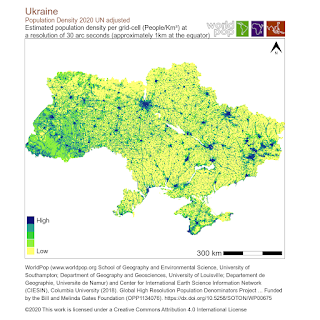
Ukraine has been on my mind lately. News stories regularly try to sum up the current state of suffering: As of Tuesday morning, 401 civilians confirmed dead and 801 confirmed injured, with the actual casualties likely much higher. More than 2 million refugees. But that’s just the big picture. Like a fractal, you can zoom in to see more and more detail, and more and more suffering. A wedding with military fatigues and rocket-propelled grenades. Reports of a girl, trapped in rubble, dying of dehydration. Photos of farewells at train stations as the war separates families. A man digging through the rubble of his house after his wife and daughter were killed.

Or you can follow a different branch of the fractal tree to look at Russia: 140 million people in an economy that’s cratered under crippling sanctions, a government that may be about to default on its debts, thousands of Russian soldiers killed, under a regime so repressive that merely calling what’s happening in Ukraine an “invasion” can be punishable by up to three years in prison. All for a war that none of them had any real say in.

Let’s zoom out a step. Here’s a map of the Russian invasion of Ukraine as of this week, courtesy of The Washington Post.

Ukraine’s population is (was) 43 million people. Plenty of those 43 million people live outside of the red areas.

I don’t know how the demographics break down - how many of the casualties and refugees are from different parts of the country - but, given that Putin’s aim appears to be to take all of Ukraine, it’s easy to fear that things could get much worse.

Let’s zoom out again. Here’s Moldova.

It’s another former member of the Soviet Union, just south of Ukraine, small and (like Ukraine) relatively poor. Moldovans worry that their country will be invaded next, especially after Belorusian dictator and Russian ally Alexander Lukashenko showed a map that appeared to indicate planned troop movements into Moldova. Moldova has its own separatist region, Transnistria, similar to Ukraine’s separatist, Russian-friendly regions of Donetsk and Luhansk. Transnistria is tiny (500,000 people), completely outside of Moldovan control, and backwater:

It’s a place of Lenin statues, hammer-and-sickle flags and once-grand Soviet architecture in decay… Unrecognized by the United Nations, it has a currency, the ruble, that is virtually worthless outside its borders. International bank cards don’t work at Transnistrian ATMs. Salaries are low. For all of Russia’s influence, the biggest power in Transnistria is a monopolistic company, Sheriff, that operates with scant oversight and controls everything from the gas stations to the supermarkets to the soccer club.

Anywhere along the fractal, it seems, we can see more loss, more fear, more scars from the past. And that’s just from looking at current events in and around Ukraine. We can follow the branches back through history, to look at the Russian poverty and malaise after the collapse of the Soviet Union that fueled Putin’s rise to power, or the history of autocracy, imperialism, and politicized religion that Putin has inherited. Or we can zoom out further and follow the fractal’s boughs to the civil war in Ethiopia between Tigray and the central government, with “ethnically motivated killings, sexual violence on a massive scale, looting, and mass displacement to unequipped neighbor states and countries”; or the civil war in Yemen, where Saudi Arabia, using US-provided weaponry, is waging a brutal war against Houthi rebels that’s killed over 100,000 people and started a famine that’s killed 85,000 more.

And, of course, if you follow the branches and boughs back far enough, you come to the Fall, to humanity’s rebellion against God that started in Eden and ripples throughout history and throughout the world.

What’s a Christian to do? Or, to be more direct, what is God doing? Our typical answer is that Jesus’ death and resurrection means we can escape all of this and go to Heaven. And that’s true, good, and wonderful, but it’s only part of the story. After all, it would seem strange if God saw this infinite fractal of pain, loss, and death and gave only a single, unitary response. Instead, I believe, God’s redemption and its outworking are similarly fractal, being rooted in Christ’s death, burial, and resurrection but branching out into every aspect of our existence:

  • God at work in the thousands of blessings of everyday life - good meals and sunrises and jokes with friends and a sound night’s sleep
  • God at work in the arcs of our individual lives, guiding us as we live and work and learn and grow
  • God at work in the local church, where we share in the love and support of our brothers and sisters as we worship and serve
  • God at work in society, as believers and non-believers alike work under God’s common grace to treat poverty and illness, address injustice, and otherwise ameliorate the effects of the Fall
  • God at work through his Word, speaking to us today just as he spoke to its human authors, and speaking to us through the millions of lesser words of Christian preachers, speakers, authors, singers, songwriters, theologians, and journalists who use their gifts to build us up
  • God at work even in our hardships, as our hardships help us to develop endurance, character, and hope (Rom 5:4); provide an opportunity to show our faith and gentleness (1 Pe 3:13-16); and inspire others (as Ukrainians’ courage is inspiring many around the world)
  • God at work throughout history, as his church spreads the gospel “throughout the whole inhabited earth as a testimony to all the nations” (Mt 24:14)
  • God at work through Jesus, who exactly reveals God to us, and whom we can know and relate to as surely as the disciples who walked on earth with him 2,000 years ago
  • God at work through the promise of a new heaven and a new earth, where the Fall is not merely escaped but destroyed, where “he will live among us, and we will be his people, and God himself will be with us, and he will wipe away every tear from our eyes, and death will not exist any more—or mourning, or crying, or pain” (Rev. 21:3-4, paraphrased)

Wednesday, March 2, 2022

Peace on Earth

A friend of mine left church early yesterday so that he could make it to his family’s Christmas celebration. Now, I know that there are a wide variety of Christmas traditions, but late February doesn’t seem to work for any of them - too late for Epiphany, way too early for Christmas in July, etc. He explained, however, that this was simply when his family could get together. I’ve done the same in the past, thanks to having family scattered from North Carolina to Michigan; I think our record was a family Christmas get-together in April.

Despite the calendar mismatch, the mention of Christmas put me in the mind of Christmas songs. Not the traditional, happy carols like “Joy to the World” and “O Come All Ye Faithful” (although I do love those). Nor the modern, intricate instrumentals of Trans-Siberian Orchestra or Mannheim Steamroller (although I do love those, too). Instead, I was thinking of the not-so-happy songs, like U2’s “Peace on Earth”:

They’re reading names out over the radio All the folks, the rest of us, won’t get to know Sean and Julia, Gareth, Ann and Breda Their lives are bigger than any big idea

Jesus can you take the time To throw a drowning man a line Peace on Earth To tell the ones who hear no sound Whose sons are living in the ground Peace on Earth Jesus in the song you wrote The words are sticking in my throat Peace on Earth Hear it every Christmas time But hope and history won’t rhyme So what’s it worth? This peace on Earth

Sean, Julia, Gareth, Ann, and Breda were victims of the Omagh bombing in Northern Ireland on August 15, 1998.

Or “I Heard the Bells on Christmas Day”:

I heard the bells on Christmas day Their old familiar carols play; In music sweet the tones repeat, “There’s peace on earth, good will to men.”

And in despair I bowed my head: “There is no peace on earth,” I said, “For hate is strong, and mocks the song Of peace on earth, good will to men.”

Henry Wadsworth Longfellow wrote the poem upon which this song was based in 1863, during the height of the American Civil War. His wife had died in a fire two years earlier, and he had received word that his son, who had joined the Union Army without his blessing, had been severely injured in battle.

And this seems like a downer - inappropriate Christmas songs for an inappropriate Christmas season - but there’s a lot to be down about right now.

An unprovoked war rages in Ukraine, leaving hundreds dead and hundreds of thousands fleeing their homes, and it’s just starting.

Economic hardship is bearing down on 140 million Russians, most of whom have little or no involvement in the war.

India remains conspicuously neutral, because of their own past conflicts and history with the West.

Civil war in Ethiopia continues, with thousands dead and 2.5 million displaced, with a fraction of the attention that the war in Ukraine has received. (Because people aren’t concerned about it threatening surrounding countries? Because they don’t look like us? I don’t know.)

There is much evil in the world.

And that’s to say nothing of the smaller, personal tragedies hitting those around me: A beloved church elder and businessman dies suddenly from Covid. A young couple’s marriage falls into pieces. A family deals with the fallout of their daughter’s molestation. Another man battles cancer while weighed down by depression, a history of health problems, and bad medical advice. A family copes with the revelation that their newborn has a fatal genetic disease. All of these pale in size and scope to wars in Ukraine or Ethiopia, but that makes them scarcely less painful to those affected.

Sometimes downer songs are an appropriate response - to mourn those lost, to acknowledge if we’re drowning or bowing our heads in despair, to feel the gulf between Christian hope and humanity’s history. In Biblical terms, to lament. Because these Christmas songs also remind us that lament isn’t the end. Longfellow’s carol continues:

Then pealed the bells more loud and deep: “God is not dead, nor does He sleep, The wrong shall fail, the right prevail, With peace on earth, good will to men.”

Then ringing singing on its way The world revolved from night to day A voice, a chime, a chant sublime Of peace on earth good will to men.

Christ has come! God is with us. And he has promised to make all things right, to defeat evil and death, to wipe away every tear, to remove mourning and crying and pain (Rev. 21:3-4).

And, even when we can’t hear the Christmas bells’ promise - when, like U2, the words stick in our throat and we’re left wondering what it’s worth - the act of bringing these laments to God is itself a statement of faith in God. Because we know that Immanuel, God with us, means that Christ has experienced the same hurts that we have, that he has taken the world’s evil upon himself, that he is with us even in the midst of our despair.

Thursday, September 16, 2021

Outraged

“I just feel angry all the time.”

So shared a Christian friend of mine last week. “I feel like I’m going to snap. There’s so much wrong in society right now,” he continued.

I can sympathize. Maybe not about all the specifics - my political views don’t quite align with his - but certainly with the general sentiment. Over the last eighteen months in particular, there’s been a lot to feel angry about. And a lot of people have snapped:

  • On July 31, an airline passenger allegedly assaulted and groped three flight attendants. He was duct-taped to his seat to get him under control.
  • On July 6, a woman allegedly tried to exit an airplane in midflight. She was duct-taped to her seat to restrain her.
  • In May, a flight attendant lost two teeth after being assaulted by a passenger.
  • Nearly half of McDonald’s workers were verbally or physically assaulted over the summer of 2020.
  • At least four employees have been killed in fights over masks.
  • Domestic abuse rates have spiked since the pandemic started. According to Time: “300% in Hubei, China; 25% in Argentina, 30% in Cyprus, 33% in Singapore and 50% in Brazil… 18% in San Antonio, 22% in Portland, Ore.; and 10% in New York City… One study in the journal Radiology reports that at Brigham and Women’s Hospital in Boston, radiology scans and superficial wounds consistent with domestic abuse from March 11 to May 3 of this year exceeded the totals for the same period in 2018 and 2019 combined.”

I could go on for quite some time. And that’s without getting into the deeper fault lines over race, politics, religion, and economic differences. There’s so much to be angry about. To quote Heather Heyer, “If you’re not outraged, you’re not paying attention.” (Heather Heyer was herself a victim of the anger of the last five years; she was killed when someone drove a car into her during the Charlottesville, VA protests in 2017.)

“Be angry and do not sin; do not let the sun go down on the cause of your anger. Do not give the devil an opportunity.” - Eph. 4:26-27

By itself, anger is just a feeling, right? And feelings are simply part of being human; they aren’t automatically good, bad, moral, or immoral, any more than being tall or short or breathing oxygen or drinking milk or any other facet of being a human. Dallas Willard defines anger:

In its simplest form, anger is a spontaneous response that has a vital function in life. As such, it is not wrong. It is a feeling that seizes us in our body and immediately impels us toward interfering with, and possibly even harming, those who have thwarted our will and interfered with our life… The primary function of anger in life is to alert me to an obstruction to my will, and immediately raise alarm and resistance, before I even have time to think about it. (The Divine Conspiracy, p. 147-148)

This clarifies the situation: the reason everyone’s so angry is because there are so many obstructions to people’s wills right now. We will to go to restaurants and social gatherings without restriction or fear; to know that those around us are taking appropriate health precautions; to not have unreasonable health precautions forced upon us; to read the news without seeing the latest Democrat or Republican outrage; to work a stable job; to not lose loved ones. These wants and so many others have been repeatedly dashed over the last eighteen months.

“O Lord, do I not hate those who hate you and despise those who oppose you?” - Psalm 139:21

Add to that the deeper causes for anger. We will for there to be racial harmony and justice; for sufficient resources for the poor; for a society that correctly balances and exercises freedom and responsibility; for political leaders who demonstrate moral character and promote moral policies; for freedom from natural disasters like Haiti’s earthquake and Hurricane Ida; for peace and justice for war-torn countries like Afghanistan and oppressed peoples like the Uyghurs of China. And, as Christians, we will for God’s kingdom to come and God’s will to be done on an earth where it so often isn’t. All of these wants, too, are repeatedly dashed. Righteous indignation is a natural response: to respond, like the psalmist in Psalm 139, with anger toward the enemies of God.

“The anger of the Lord will not turn back until he has fully carried out his intended purposes. In future days you will come to understand this.” - Jer. 30:24

And righteous indignation has a place. And it can be rather intoxicating: the rush of being angry, combined with the moral certitude that we’re right and the pleasure of being able to judge others. But the critical assumption behind hating God’s enemies is that we can correctly identify who God’s enemies are; we too often forget that, in present days, we may not yet understand his intended purposes. Because racism and poverty and political leadership and foreign policy are all wicked problems, and just maybe some of the people we think are God’s enemies actually have better ideas about how to address these temporal problems than we do, and just maybe some of the people we think are God’s enemies are actually appointed by him (for example, Isa. 45:1) for purposes we may not yet see.

The psalmist said in Psalm 139:21 that he hates God’s enemies, but that was only after Psalm 139:1-18, where he meditates on the mystery of God’s omniscience and the limitations of the psalmist’s own ability to understand him. And David demonstrated this attitude in his own life: when Absalom rebelled against him and David fled Jerusalem for his life, he refused to take action against a man who cursed him, because he realized that it was possible that he was in the wrong and that this opposition was from the Lord (2 Sam 16:5-12).

“The Lord passed by before him [Moses] and proclaimed: “The Lord, the Lord, the compassionate and gracious God, slow to anger, and abounding in loyal love and faithfulness, keeping loyal love for thousands [of generations], forgiving iniquity and transgression and sin. But he by no means leaves the guilty unpunished, responding to the transgression of fathers by dealing with children and children’s children, to the third and fourth generation.”” - Ex. 34:6-7

And, however much righteous indignation we may experience at the state of the world, however much we feel anger at having our will for the world thwarted, God could be said to experience even more. Not that his will can be meaningfully thwarted (it would be wrong to suggest that of an omnipotent God), but there’s a great deal that he has said is contrary to his will, and he knows all of it - every cutting remark and broken relationship and falsehood of our political partisanship, every story of every suffering person who we see only briefly in photographs and newscasts from foreign correspondents, every hunger pang and addict’s craving, every act of greed and selfishness and bigotry and rage. And it does make him angry - in fact, the Bible talks quite a lot about the wrath of God - but, as shown in God’s glorious self-revelation to Moses, his love and forgiveness outweighs his anger hundreds of times over.

“Where do the conflicts and where do the quarrels among you come from? Is it not from this, from your passions that battle inside you? You desire and you do not have; you murder and envy and you cannot obtain; you quarrel and fight.” - James 4:1-2

Because the other aspect of the problem is that our “righteous” indignation isn’t nearly so pure as God’s. Our hearts are deceitful (Jer. 17:9), and that includes deceiving us into mistaking our warring passions for righteous anger. And modern society encourages and accelerates this: social media divorces people’s words from their actions and lives, so that all we can judge are the words. Technology has made sharing these words effectively free, so the supply becomes effectively infinite, and the constraint - what determines whose words are consumed - becomes people’s attention. And the easiest way to attract attention, in both traditional media and social media, is to be extreme, inflammatory, to rile up the emotions of the people on your side and to provoke inflammatory responses from people on the other side, because that just draws more attention. And so voices that are calmer, more moderate, more loving get crowded out. Pundits and politicians keep adding fuel to the fire - some of them because they’re deliberately quarreling and fighting and spreading falsehoods to get what they do not have, and some of them because their hearts, too, have deceived them. And, too often, we willingly participate, by joining in the debates and listening to the pundits and politicians and giving platform and fame to those who inflame and divide.

“Let every person be quick to listen, slow to speak, slow to anger.” - James 1:19

If anger is merely my response to my will being thwarted, then the Bible offers a different way of dealing with it. If I’m humble enough to recognize the limits of my own agenda and let go of my own ego, if I remember that there are things more important than my task list, then I can let go of my anger when my computer doesn’t work or I’m stuck in traffic or I get a frustrating work email or my kids don’t do what I want. If I pour my love and attention into my relationships with those around me, then I can accept when their wills interfere with mine. Remembering that “this present world is a perfectly safe place for us to be” (Dallas Willard, echoing Mt. 6:25-34) helps me take the losses of the pandemic in stride - not that it doesn’t hurt, and not that we don’t feel anger, but we put it in its place, because we know the bigger picture and how it all ends. If I remember that it’s the Spirit’s job to change people and that God is still working on us (Phil. 2:12-13, 3:15), then I can accept when people don’t agree with me. I can choose to prioritize Christian community over social media tribalism; I can place my hope in God rather than in politics; I can seek truth and understanding instead of seeking for my side to win.

“For human anger does not accomplish God’s righteousness.” - James 1:20

Anger has a place. There are things in life that are contrary to God’s will, and that’s something that we need to care about. But, even at its best, I’m not sure that our righteous anger does much to accomplish God’s righteousness. And, ultimately, God’s own anger did not accomplish his righteousness: that was done by his love, poured out on the cross.

So let’s follow his example. “Be angry and do not sin” when the situation calls for it, but grieve and lament as well - those are also biblical, and they’re too often neglected. Relax our grip on our own egos and desires so that we can accept when our wills are thwarted. Take a step back from the warring passions of contemporary media and spend more time in true community. And love one another.

Tuesday, May 11, 2021

Gradually Then Suddenly

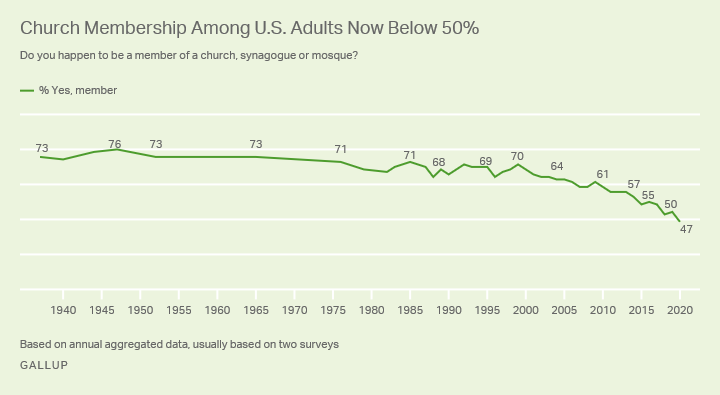
About a month ago, Gallup published new research showing that, for the first time, the percentage of Americans who are church members fell below 50%.

This, by itself, may not be too surprising. Many of us have some general awareness that American culture is less religious than it used to be. What’s really surprising is how quickly it’s happened:

Chart of church membership in America

What’s going on? What changed in 2000 (to pick a nice round number) to cause the rate of decline to accelerate so much?

I’m not a sociologist or a professional minister; there are others who are better qualified to speak than I. But, looking at that chart, I’m reminded of a quote from Ernest Hemingway’s The Sun Also Rises:

“How did you go bankrupt?”

“Two ways. Gradually, then suddenly.”

This is one of those pithy, attention-grabbing quotes that seems contradictory but, upon reflection, contains a lot of truth. Because that’s often how bankruptcy works - a household or a business may be able to continue for quite a while living just a bit beyond their means, making the minimum credit card payments, or with expenses gradually creeping up while sales gradually creep down. Then something hits - there’s an unexpected medical expense or costly repair, or one too many late payments cause fees and penalties to snowball, or an economic dip or competitive pressure suddenly makes the fragile business unsustainable - and bankruptcy occurs seemingly all at once.

Looking at that Gallup chart, I can’t help but think that something similar happened here. A healthy, vibrant church, full of active, committed Christians, doesn’t simply have its membership plummet in less than a single generation; I can’t help but wonder what kind of gradually-then-suddenly scenario American Christendom has been going through, what weaknesses we’ve allowed to fester and grow until our position became untenable in the face of a worldly culture.

It’s easy to guess at what those weaknesses might be. I suspect that part of the decline is because we’ve too uncritically allied ourselves with particular political agendas and a particular political party; even when those causes have been good, it’s hard to maintain our distinctiveness when the broader culture sees us as yet another political interest group. Russell Moore writes:

Even as a teenager, I could see that the “voting guides” that showed up in Bible Belt America were kind of like the horoscopes one could find in the newspaper. The horoscope could say, “Today you will find a surprising new opportunity,” and a certain sort of credulous person would be amazed at how this just happened to be true—without ever thinking about the fact that this is true of virtually every human being at virtually every moment, if one just pays attention to it. Likewise, the voter guides lined out the “Christian” view from the “anti-Christian view” on a list of issues that just happened to line up with the favored party’s platform that year. Somehow the Bible suddenly gave us a “Christian view” on a balanced budget amendment or a line-item veto, things that… were never noticed in the text until the favored candidates started emphasizing such things.

And along with all that came apocalyptic warnings that if these candidates weren’t elected, or these policies weren’t enacted, we would “lose our entire culture.” But when those candidates lost, no one headed for the bunkers. The culture didn’t fall—at least not any more than it had before.

The sad fact is that, for many Americans, the only experience they have with evangelicals is at a distance, as their opponents at the ballot box. To borrow from Philip Yancey and Gregory Boyd, it’s incredibly difficult to extend grace to people when you’re also trying to defeat them politically; it’s hard to advance both the kingdom of the cross (which transforms people from the inside) and an earthly government (which can merely compel external behavior).

I suspect that part of the decline of the American church is because we’ve allowed moralism and legalism to be portrayed as key parts of Christianity. This shows up in a variety of ways - an emphasis on “obvious” sins like sexual immorality, alcoholism, and drug addiction instead of subtler sins like pride and dishonesty and bitterness, as well as picking out everything from R-rated movies to teetotaling to particular styles of clothing to Dungeons & Dragons to violent video games as vital moral issues. Please don’t misunderstand me. Morality - trying to live a life pleasing to our Creator, following the way he wants us to live - is obviously incredibly important. And I love that my brothers and sisters have been trying to apply God’s standards to every facet of their lives - R-rated movies and teatotalling and the rest - because examining every facet of our lives and living with a clear conscience is also part of trying to live a life pleasing to our Creator. I’m even in agreement on a decent amount of this. But the problem comes when we set up these as a central aspect of the faith, rather than our best human effort to live out our faith; people mistake the legalism for the Gospel and walk away from it all, or they see the inconsistencies in our causes or the flawed, human, sometimes arbitrary morality (because we’re all flawed and human and sometimes arbitrary) and think that the whole of the faith is that. In The Life You’ve Always Wanted, John Ortberg suggests that part of the problem is that we let these moral issues become “boundary markers” - “highly visible, relatively superficial practices - matters of vocabulary or dress or style - whose purpose is to distinguish between those inside a group and those who are outside”:

The church I grew up in was a fine church, and I am deeply in its dept, but we also had our own set of markers there. The senior pastor could have been consumed with pride or resentment, but as long as his preaching was orthodox and the church was growing, his job would probably not be in jeopardy. But if some Sunday morning he had been smoking a cigarette while greeting people after the service, he would not have been around for the evening service. Why? No one at the church would have said that smoking a single Camel was a worse sin than a life consumed by pride and resentment. But for us, cigarette-smoking became an identity marker. It was one of the ways we were able to tell the sheep from the goats…

A boundary-oriented approach to spirituality focuses on people’s position: Are you inside or outside the group? A great deal of energy is spent clarifying what counts as a boundary marker.

But Jesus consistently focused on people’s center. Are they oriented and moving toward the center of spiritual life (love of God and people), or are they moving away from it? (p. 34-37)

I suspect that part of the decline is specific sins that we’ve allowed within the church: the racism of the American south, sexual abuse within the Catholic priesthood and other churches, financial exploitation by televangelists and others. The sad fact is that we have a lot to answer for here. White southern evangelicals did little to help the civil rights movement, and many of our private Christian schools in the south were founded in the wake of Brown v. Board of Education by whites who wanted an alternative to the newly desegregated public schools. Sexual abuse by religious leaders and organizations from Catholic priests to Ravi Zacharias to Kamp Kanakuk have done grievous harm; organizations frequently chose to protect themselves or the perpetrator (for example, by trying to handle it internally) rather than prioritizing bringing justice for the victim, and Christian teachings such as Bill Gothard’s downplayed the harm and blamed the victims (before Gothard himself was accused of repeated sexual harassment). Christian leaders such as Jim Bakker, Jimmy Swaggart, Ted Haggard, and Jerry Falwell Jr. have all had heavily publicized scandals. These aren’t just “a few bad apples”; I’ve read too many accounts of racism, of theology that’s abused to excuse sexual sin, of a willingness to overlook warning signs if a ministry is successful, of preying on people’s political fears or luring them with health-and-wealth. We need to repent. Now, especially, when the broader American culture is seriously confronting sexual harassment and abuse and America’s history of racism - through some mix of God’s common grace and fallen human moralism - the church’s failings in these areas become even more glaring. I’m afraid that we at times even let attitudes on race and sex become boundary markers themselves - “secular progressives are emphasizing these things, so we’re instead going to de-emphasize them, because those guys are our enemies.” This should not be.

And I suspect that part of the decline may be that some of the church membership and church activities from 2000 and earlier was, in fact, just going through the motions. In a 2014 column, Ross Douthat suggests that we’re seeing “the Christian Penumbra”:

Here is a seeming paradox of American life. On the one hand, there is a broad social-science correlation between religious faith and various social goods — health and happiness, upward mobility, social trust, charitable work and civic participation.

Yet at the same time, some of the most religious areas of the country — the Bible Belt, the deepest South — struggle mightily with poverty, poor health, political corruption and social disarray…

The social goods associated with faith flow almost exclusively from religious participation, not from affiliation or nominal belief. And where practice ceases or diminishes, in what you might call America’s “Christian penumbra,” the remaining residue of religion can be socially damaging instead…

It isn’t hard to see why this might be. In the Christian penumbra, certain religious expectations could endure (a bias toward early marriage, for instance) without support networks for people struggling to live up to them. Or specific moral ideas could still have purchase without being embedded in a plausible life script. (For instance, residual pro-life sentiment could increase out-of-wedlock births.) Or religious impulses could survive in dark forms rather than positive ones — leaving structures of hypocrisy intact and ratifying social hierarchies, without inculcating virtue, charity or responsibility.

And it isn’t hard to see places in American life where these patterns could be at work. Among those working-class whites whose identification with Christianity is mostly a form of identity politics, for instance. Or among second-generation Hispanic immigrants who have drifted from their ancestral Catholicism. Or in African-American communities where the church is respected as an institution without attracting many young men on Sunday morning.

Several Christian leaders have suggested that religious faith within a family follows a regular pattern: The initial converts of the first generation are active and passionate in their faith. Their children, the second generation, inherit their parents’ faith; they’re still active, and their faith is still meaningful, but they lack the firsthand commitment and passion of their parents. As a result, in the third generation, religion is more of a formality, just going through the motions. The fourth generation then leaves the faith completely.

All of this is, of course, a generalization; every family is unique, and plenty of families (including my own!) have a powerful, multi-generational legacy of faith. But it’s a penetrating illustration. I suspect that much of church membership has been these “third-generation Christians,” going through the motions, and what shows up in the polls as church decline is merely the next step of the decay. The remedy is for each generation to be the first: each new generation of Christians must make that personal, passionate, first-hand commitment for themselves.

I grieve over the American church’s decline. I love the church, and I believe that it can offer enormous good; I love Christ, and I want people to know him. But, if what I said is accurate, if what we’re seeing is the merely the next step of the Christian penumbra and nominal third-generation faith, then it may not even be a bad thing. C.S. Lewis observes in Mere Christianity, “When a young man who has been going to church in a routine way honestly realises that he does not believe in Christianity and stops going-provided he does it for honesty’s sake and not just to annoy his parents-the spirit of Christ is probably nearer to him then than it ever was before.” Christian novelist Leif Enger writes,

If I may offer a perspective on the church ‘losing a generation,’ it’s worth considering that widespread disillusionment with evangelicalism is largely a positive development. I can’t speak for a soul outside my experience, but as the product of Midwestern charismatics who subscribed early to Fox News and never looked back, I suspect the progression from Falwell Sr. to Falwell Jr. applies more broadly than any of us care to imagine. A teen who sees through the rot and ‘falls away’ remains as available to the Creator as any prodigal in history; those who remain despite the rot will learn to tolerate it, follow it, and finally exalt it. This is predictable and proven before our eyes. At this fraught moment it’s the non-skeptics I dread.

God is still at work, in his church and in the world. The story isn’t over yet, not for the individuals whose decisions make up the decline or for the American church as a whole. Church attendance numbers and cultural influence are nice, but the point is following Christ. The Gallup polls show a snapshot in time, but we know that ultimately the gates of hell will not prevail and every knee shall bow (Matt. 16:18, Phil. 2:10).

So let’s re-center our lives and our faith on Christ and his kingdom, not on political causes.

Let our morality flow out of following Christ, rather than being a legalistic cause and identity marker.

Confront and repent of our sin.

Commit to Christ, and teach our children to do the same.

Further reading:

  • Russell Moore’s “Losing Our Religion” wrestles with the Gallup poll’s findings and presents his personal perspective, and David French presents an Easter meditation on it.
  • Rachael Denhollander is doing critically important work on sexual abuse within the church. Her Twitter feed and her husband’s are good (and sad) reading. (I first heard about her when she extended the Gospel to her abuser, former USA Gymnastics team doctor, Larry Nassar, in courtroom testimony.)